

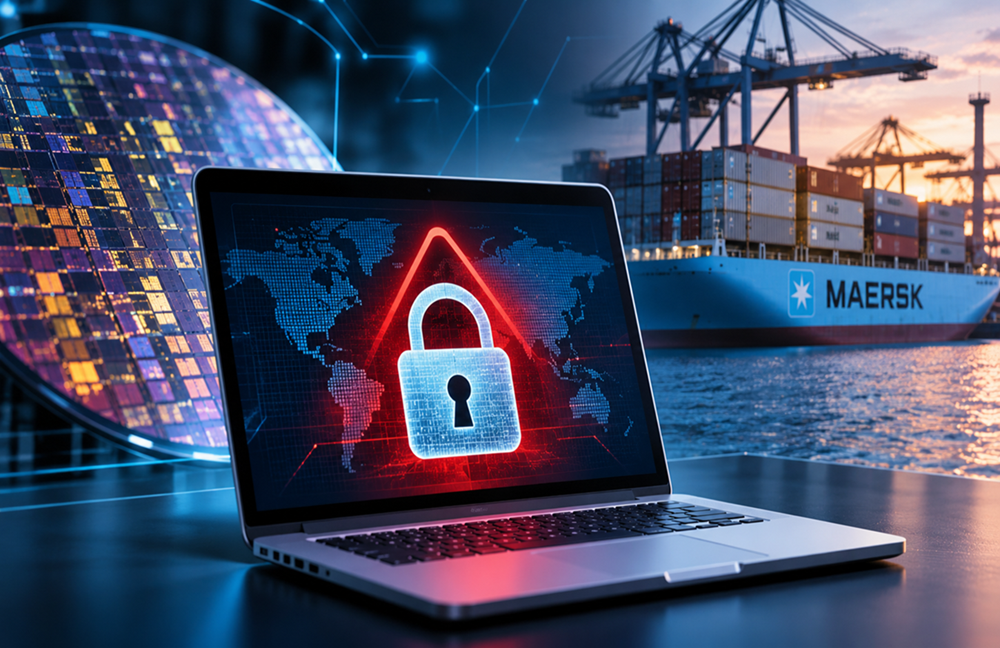
Two major cybersecurity incidents disclosed in November 2026 have highlighted a growing challenge for organizations that depend on external technology providers, cloud platforms, and inherited IT infrastructure. Taiwan Semiconductor Manufacturing Company (TSMC), one of the world’s leading semiconductor manufacturers, disclosed unauthorized exposure of employee information associated with an external cloud service provider. Meanwhile, global shipping and logistics company Maersk confirmed unauthorized access and data extraction involving a legacy system inherited through a previous acquisition.
Although the incidents involved different technologies and circumstances, they exposed a similar business risk. Organizations can invest substantially in protecting their primary networks while remaining vulnerable through systems, suppliers, and applications operating outside their immediate control. These dependencies are particularly important for healthcare providers, manufacturers, financial institutions, and professional services firms that rely on interconnected technology environments to maintain operations.
The incidents also demonstrate why cybersecurity and IT management cannot function as entirely separate disciplines. Protecting information requires understanding where it is stored, who can access it, which systems process it, and how those systems are maintained throughout their operational lives.
TSMC discloses employee data exposure associated with an external cloud provider
On November 12, 2026, TSMC filed a statement with the U.S. Securities and Exchange Commission confirming that information belonging to current and former employees had been made available on an external website without authorization. The company stated that the exposed information matched data stored within the services of an unnamed cloud provider. Importantly, TSMC reported that it had found no evidence of compromise involving its own systems and that the exposed information was unrelated to its manufacturing operations or customer data.
The disclosure followed a November 8 cybercrime forum posting in which a threat actor advertised approximately 6.9 gigabytes of allegedly stolen employee information. According to reporting by The Record, the seller claimed to possess personal information that could include identification details, contact information, and banking records. These claims originated with the alleged data seller and had not been independently confirmed by TSMC.
The company indicated that it was notifying affected personnel and providing support while working with the cloud service provider, investigating authorities, and an external cybersecurity firm to establish the circumstances of the exposure. The available disclosure did not establish the precise intrusion mechanism, making it important to distinguish confirmed unauthorized exposure from assumptions about how the information was obtained.
For organizations that use cloud-based human resources systems, payroll platforms, document repositories, and employee management applications, the incident illustrates an important security consideration. Moving information to a third-party platform does not eliminate the originating organization’s responsibility to understand how that information is protected. Businesses must evaluate provider access controls, data retention practices, incident notification procedures, and the security obligations established within their vendor agreements.
Maersk breach highlights the risks of inherited technology infrastructure
On November 11, 2026, Maersk confirmed that an unauthorized party had accessed a local legacy system associated with a previously acquired company and extracted information from that environment. The WhiteArmor extortion group claimed responsibility and alleged that it had stolen approximately 100 gigabytes of information, demanding $5 million to prevent disclosure.
According to BleepingComputer, Maersk stated that its initial investigation had not identified evidence that sensitive data had been disclosed. The company also reported no indication that the incident affected its other systems, customer operations, or connected customer and partner platforms. These findings were preliminary, and the amount of information claimed by the attackers had not been independently verified.
The incident raises questions about how organizations manage technology inherited through mergers and acquisitions. Acquired businesses frequently bring existing networks, applications, databases, user accounts, and infrastructure configurations that may differ considerably from the acquiring organization’s established standards. Integrating these environments requires more than connecting systems and transferring operational responsibilities.
Legacy applications may contain outdated software, unsupported components, inconsistent access permissions, or undocumented integrations. Even when these systems remain functional, their security posture can deteriorate if maintenance responsibilities are unclear or if they operate outside centralized monitoring and vulnerability management programs.
For organizations expanding through acquisitions, inherited technology should undergo formal security assessments, infrastructure reviews, access audits, and modernization planning. Systems that cannot be immediately replaced may require additional isolation, monitoring, or compensating controls to reduce exposure.
Why third-party cybersecurity has become an executive responsibility
The TSMC and Maersk incidents illustrate different aspects of the same governance challenge. In TSMC’s case, the exposed information was associated with an external cloud provider. In Maersk’s case, the affected technology was an inherited legacy system. Neither incident establishes that the organizations’ primary production environments were compromised, yet both required investigation and coordinated responses.
Modern businesses depend on external software providers, cloud infrastructure, technology consultants, managed service providers, and specialized applications. Each relationship can introduce additional security responsibilities, particularly when vendors store confidential information or maintain privileged access to business systems.
Organizations investing in managed cybersecurity services can strengthen their security operations through coordinated threat monitoring, vulnerability management, detection, and incident response capabilities. However, businesses should also determine whether their cybersecurity arrangements explicitly address third-party risk assessments, cloud configuration reviews, vendor access governance, and inherited technology environments.
Security tools alone cannot resolve unclear accountability between departments or external providers. Effective cybersecurity requires documented ownership, appropriate contractual protections, regular assessments, and executive oversight of material technology dependencies.
The hidden risks of disconnected IT and cybersecurity management
A significant weakness in enterprise technology governance develops when infrastructure management and cybersecurity operate independently. IT teams may focus on system availability, software upgrades, user support, and network performance, while security teams concentrate on vulnerabilities, suspicious activity, and incident response.
Although these responsibilities are distinct, they depend on many of the same systems and operational processes. An outdated application creates both maintenance and security concerns. An undocumented cloud integration can complicate troubleshooting while introducing additional data exposure. An inactive administrative account may represent poor account management and an unnecessary security risk.
Organizations working with a Managed IT services provider can establish more consistent oversight of their technology environments through infrastructure management, system maintenance, technical support, and coordination across business applications. When IT management and cybersecurity responsibilities are clearly aligned, businesses can improve visibility into their assets, identify unsupported systems, and ensure that operational changes receive appropriate security consideration.
The objective is not simply to consolidate vendors. It is to establish a coordinated operating model in which infrastructure decisions, security requirements, and business continuity priorities support one another.
Why manufacturers and healthcare organizations face particular challenges
Manufacturing environments frequently combine traditional business applications with production systems, industrial equipment, specialized software, and supplier integrations. These technologies may have different maintenance requirements, support arrangements, and operational lifecycles. Replacing an outdated system can require production planning, compatibility testing, and coordination with equipment manufacturers, making modernization more complicated than a routine software upgrade.
Healthcare organizations face similar challenges involving electronic health records, medical devices, scheduling platforms, clinical applications, and third-party service providers. Security controls must account for sensitive information while supporting the availability of systems required for patient care and administrative operations.
Professional services firms also depend on confidential client information, cloud collaboration platforms, and external software providers. Although their infrastructure may be less complex than a manufacturing environment, they can still experience significant consequences when sensitive information is exposed or essential systems become unavailable.
Across these industries, the common requirement is an accurate understanding of technology dependencies and the responsibilities associated with protecting them.
Five priorities for reducing third-party and legacy system exposure
The November incidents provide an opportunity for business leaders to reassess how effectively their organizations manage technology beyond their primary networks.
Maintain a complete technology and data inventory
Organizations should identify the systems that store, process, or transmit sensitive information, including externally hosted applications and inherited infrastructure. The inventory should document business ownership, administrative responsibilities, vendor relationships, and relevant security requirements. Accurate records help organizations understand which systems may be affected when a provider reports an incident.
Evaluate third-party security controls
Vendor assessments should examine access management, encryption practices, vulnerability management, incident notification procedures, and contractual security obligations. Providers handling particularly sensitive information or supporting essential operations may require more extensive reviews. Organizations should also understand the limits of their visibility into external environments.
Review inherited and unsupported systems
Technology acquired through business transactions should undergo structured assessments to identify outdated applications, unnecessary user accounts, undocumented integrations, and unsupported infrastructure. Where immediate replacement is impractical, organizations should consider network segmentation, restricted access, enhanced monitoring, and documented remediation plans.
Coordinate IT operations and cybersecurity
Infrastructure teams and security personnel should share relevant information about system changes, vulnerabilities, privileged access, and emerging operational risks. Regular coordination helps ensure that maintenance activities do not introduce avoidable security weaknesses and that security recommendations account for operational requirements.
Test incident response and recovery procedures
Businesses should establish procedures for responding to incidents involving external providers or systems outside their primary infrastructure. These plans should address investigation responsibilities, evidence preservation, vendor communications, regulatory considerations, and recovery priorities. Periodic exercises can identify gaps before an actual incident occurs.
The business consequences extend beyond the initial breach
A cybersecurity incident can create operational and financial consequences even when an organization’s primary systems remain functional. Investigations require technical resources, management attention, legal review, and coordination with external parties. Businesses may also need to notify affected individuals, review contractual obligations, and strengthen controls to prevent similar incidents.
The consequences can be particularly complicated when an external provider controls essential information or when an inherited system has limited documentation. Organizations may depend on third parties to establish the scope of an incident, determine what information was accessed, and identify the technical changes required to contain the problem.
This reinforces the importance of evaluating technology dependencies before an incident occurs. Businesses should understand which providers maintain critical information, what assistance those providers must supply during investigations, and how quickly essential systems can be isolated or restored.
What the November 2026 incidents mean for business leaders
The TSMC and Maersk disclosures demonstrate that cybersecurity exposure extends beyond the boundaries of an organization’s primary network. External cloud providers and inherited legacy systems can introduce risks that remain difficult to identify without coordinated oversight.
These incidents do not establish that every organization using cloud services or legacy technology faces an imminent breach. They do, however, illustrate why businesses must understand their technology dependencies and establish clear responsibilities for maintaining and securing them.
For mid-sized organizations, the priority should be developing a technology management strategy that connects infrastructure maintenance, cybersecurity monitoring, vendor oversight, and incident response. Organizations that maintain accurate system inventories, evaluate external providers, modernize unsupported infrastructure, and coordinate IT and security responsibilities will be better positioned to identify vulnerabilities and respond effectively when incidents occur.
As enterprise technology environments become increasingly interconnected, cybersecurity must be treated as an ongoing operational responsibility rather than an isolated technical function. The ability to understand and manage external dependencies is becoming an essential component of protecting information, maintaining business continuity, and supporting long-term organizational resilience.
Sources and references
1. TSMC, November 12, 2026. Statement regarding unauthorized access of employee personal data, Form 6-K filed with the U.S. Securities and Exchange Commission.
https://www.sec.gov/Archives/edgar/data/1046179/000104617926000800/a20261112statementregardin.htm
2. The Record, November 13, 2026. TSMC confirms employee data breach tied to cloud service provider.
https://therecord.media/tsmc-confirms-employee-data-breach-cloud-provider
3. Maersk, November 11, 2026. Official IT security incident statement.
https://www.maersk.com/news/articles/2026/11/11/it-security-incident
4. BleepingComputer, November 11, 2026. Maersk confirms data breach as WhiteArmor ransomware demands $5 million.
https://www.bleepingcomputer.com/news/security/maersk-confirms-data-breach-as-whitearmor-ransomware-demands-5-million/
5. Check Point Research, November 16, 2026. Threat Intelligence Report covering November 9–15, 2026.
https://research.checkpoint.com/2026/16th-november-threat-intelligence-report/
