

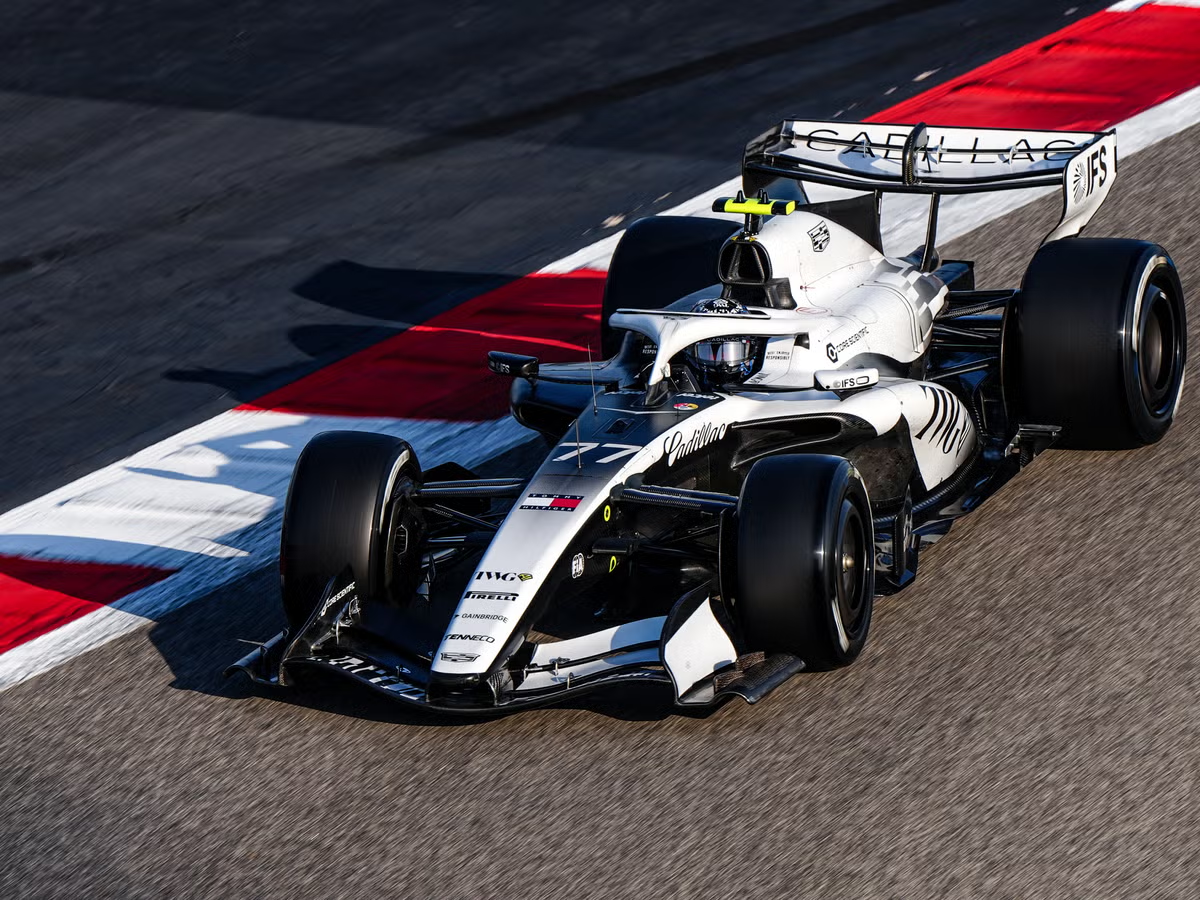
Formula One’s expansion to eleven constructor entries has generated the sport’s most significant competitive landscape change in decades — and no new entry has attracted the commercial attention, national pride, and competitive anticipation that the Cadillac F1 team’s arrival brings. An American manufacturer competing under an American brand name in the world’s premier motorsport series, entering a grid where American drivers have been largely absent for years, and doing so at a moment when Formula One’s American audience growth has been the sport’s most significant commercial development — the timing and identity of Cadillac’s entry creates a narrative whose significance extends well beyond the lap times their car initially produces. Fans following every aspect of F1 competition can find dedicated markets at dbbet-tz.com.
The Background: How Cadillac Earned Its F1 Entry
The cadillac f1 team entry into Formula One represents the conclusion of a process that involved years of lobbying, regulatory navigation, and the specific political dynamics of the FIA’s constructor entry approval mechanism. General Motors’ commitment to bringing the Cadillac brand into Formula One — the sport whose technical demands and global visibility represent the ultimate automotive marketing platform — reflected a strategic assessment that Formula One’s growth in American markets created a commercial opportunity whose timing would not remain available indefinitely.
The entry approval process navigated resistance from existing teams whose commercial arrangements include provisions about new entry dilution of prize fund distributions — a financial reality that made existing constructors less than enthusiastic about welcoming a competitor whose arrival reduced their individual share of commercial revenue regardless of competitive merit. The FIA’s ultimate approval of the Cadillac entry over constructor objections reflected regulatory authority asserting sporting governance principles against purely commercial resistance.
The backing of Andretti Global — the racing organization founded by Michael Andretti whose name carries specific resonance within American motorsport — added a competitive credibility dimension to what might otherwise have appeared a purely commercial branding exercise. The combination of General Motors’ engineering resources and Andretti’s motorsport operational experience created the foundation that an F1 entry requires across both its technical and sporting dimensions.
Cadillac F1 Drivers: Building the Lineup
The cadillac f1 drivers selection represents one of the entry’s most consequential decisions — the specific combination of experience, development potential, and commercial value that a new constructor must balance against each other in ways that established teams with proven organizational environments do not face in quite the same concentrated form.
A new team entering Formula One faces a driver market reality that its unproven competitive machinery complicates — the most experienced and fastest drivers available are not automatically accessible to an entry that cannot yet demonstrate the car performance that competitive drivers require to justify choosing a new constructor over established alternatives with proven race-winning capability. The driver lineup that Cadillac fields in its competitive debut reflects the specific balance available within this constraint — drivers whose combination of talent, development potential, and willingness to be part of a building project suits the specific circumstance of a well-resourced but developmentally early constructor.
The American driver angle carries specific commercial significance that Cadillac’s marketing rationale makes genuinely important alongside pure sporting merit — an American constructor competing in Formula One’s American markets with American drivers creates the complete national identity narrative that the entry’s commercial justification partly depends upon. Whether the available American driver talent meets the competitive standards that F1 requires at this specific moment in the sport’s development is the question that shapes how completely that narrative can be delivered.
The Power Unit Question: GM’s Technical Development
One of the most significant aspects of Cadillac’s Formula One entry is General Motors’ stated commitment to developing a proprietary power unit for the team — a technical ambition whose implications for the team’s long-term competitive trajectory are more significant than any other single technical decision.
Formula One’s power unit regulations — governing the hybrid internal combustion and energy recovery systems that produce competitive performance differences whose magnitude has defined championship outcomes across the hybrid era — represent the sport’s most technically demanding development challenge. The gap between an established power unit manufacturer with decades of F1-specific development experience and a new entrant building that knowledge from foundational principles is genuinely enormous — a developmental timeline measured in years rather than months regardless of the engineering resources applied to the challenge.
The interim power unit arrangement — using an established manufacturer’s supply while the GM development program matures — reflects an understanding that immediate competitiveness requires solutions that the long-term technical development program cannot yet provide. How quickly the GM power unit development reaches competitive parity with established suppliers will determine more than any other technical factor whether Cadillac can progress from grid participant to genuine competitive force within their entry’s first decade.
Organizational Structure: Building an F1 Team
Constructing a Formula One team from organizational foundations requires assembling expertise across multiple specialist domains simultaneously — aerodynamic development, power unit integration, chassis engineering, race operations, and the data analytics infrastructure that modern F1 competition demands — within timelines that the competitive calendar does not adjust to accommodate developmental convenience.
The hiring strategy that Cadillac has pursued — recruiting experienced F1 personnel from established constructors whose institutional knowledge accelerates the new team’s development across every operational dimension — reflects the only genuinely viable approach to compressing the learning curve that building F1 operational capability from limited foundations requires. Engineers who have developed cars within competitive F1 environments bring not merely technical knowledge but the specific understanding of how F1 development processes work — the simulation-to-track feedback loop, the regulatory interpretation that extracts maximum performance from rules frameworks, and the race weekend operational rhythms that competitive performance requires — that cannot be acquired except through direct experience.
The American F1 Audience: Why Cadillac’s Timing Matters
Formula One’s American audience transformation — driven substantially by Drive to Survive’s Netflix exposure and accelerated by race additions in Miami, Las Vegas, and Austin — has created the commercial environment that makes Cadillac’s entry timing strategically optimal in ways that would not have existed even five years earlier.
An American constructor competing in Formula One with an American brand identity arrives into a market where the sport’s fanbase has expanded dramatically but where the specifically American connection — the ability to root for a home team rather than adopting European constructors as honorary favorites — has been absent. The commercial opportunity this creates for Cadillac extends beyond Formula One’s direct broadcast and attendance revenues into the automotive marketing value that brand association with F1’s American audience generates for General Motors’ broader commercial interests.
This commercial rationale — Formula One as marketing platform whose American audience value justifies construction costs that pure motorsport financial analysis might not support — is openly acknowledged rather than concealed within Cadillac’s entry narrative, and reflects a sophisticated understanding of what F1 participation delivers beyond the trophies that pure sporting ambition pursues.
F1 Drivers Landscape and Competitive Positioning
The broader f1 drivers landscape that Cadillac enters has never been more competitive at its upper tier — the combination of Max Verstappen’s sustained excellence, the Ferrari pairing of Leclerc and Hamilton, McLaren’s Norris and Piastri, and the Mercedes resurgence under Russell and Antonelli creates a front-running competition whose quality a new constructor cannot immediately challenge regardless of resource commitment.
Realistic competitive positioning for Cadillac’s entry period focuses on midfield relevance — demonstrating car development progression that closes the gap to established constructors at a rate that validates the organizational approach without requiring championship results that the development timeline cannot yet support. The midfield’s competitive density — teams like Williams, Haas, and Sauber occupying a performance band where small development gains produce significant position changes — creates the competitive environment where Cadillac’s early results will be most meaningfully evaluated.
Progress measured across seasons rather than races — the lap time gap to established constructors reducing predictably, points accumulation building as car performance improves, and the organizational learning that each race weekend delivers being visibly incorporated into subsequent performance — represents the competitive narrative that a new constructor’s realistic ambitions should target within their entry’s first competitive phase.
Championship Goals: Short Term vs Long Term
The honest assessment of Cadillac’s championship timeline requires separating the aspirational public narrative that commercial partnerships and fan engagement demand from the technical development reality that Formula One’s competitive structure imposes on new entrants regardless of resource commitment.
Short-term goals — successfully completing the entry’s first competitive season, demonstrating car performance improvement across the year, and establishing the organizational foundations that sustained development requires — are the realistic targets whose achievement represents genuine success rather than disappointment for an entry whose baseline is necessarily humble relative to the established constructors they’re joining.
Medium-term goals across three to five seasons — regular points scoring, occasional strong results that demonstrate the development program is delivering competitive progress, and the power unit development reaching the stage where GM’s proprietary solution enters competitive evaluation — represent the milestones whose achievement would validate the entry’s organizational approach and justify continued investment commitment.
Long-term championship ambitions — the genuine belief that a decade of development and resource commitment can produce a constructor capable of competing for race victories and ultimately championship contention — reflect the scale of aspiration that General Motors’ involvement and the Andretti organization’s competitive DNA make genuinely meaningful rather than commercially convenient fiction.
What Cadillac’s Entry Means for Formula One’s Future
Formula One’s evolution into a genuinely global sport — whose American audience growth, Middle Eastern race additions, and expanding broadcast footprint reflect commercial development whose trajectory the sport’s commercial rights holders have deliberately pursued — makes Cadillac’s entry a structurally significant moment rather than merely the addition of an eleventh constructor to an existing grid.
An American manufacturer competing under an American brand name in a sport whose American audience is now large enough to influence commercial priorities creates a feedback loop between market development and competitive participation that Formula One’s governing structure has been building toward. The sport needs American participants to fully capture American commercial value — and American participants need Formula One’s global platform to justify the investment their participation requires.
Cadillac’s long-term success within this framework — whether measured in competitive results, commercial returns for General Motors, or contribution to Formula One’s American market development — will determine whether its entry represents the beginning of sustained American manufacturer presence in the sport or an episode whose ambitions exceeded what the technical and competitive realities of Formula One ultimately permitted.
